
What does the Taliban chief's death means for various stakeholders?

Both Mahinda Rajapaksa and Modi have learnt from their past mistakes. Modi has understood that Rajapaksa is a 'forever politician' that India has to live with, observes Ambassador M K Bhadrakumar.

Pakistan has too much at stake to allow even an iota of rapprochement between India and the Taliban, says Vivek Gumaste.

'The stage is set for increasing tensions in a highly volatile region as crucial as ever from a geopolitical standpoint,' predicts Claude Smadja.

This is an opportune moment in the geopolitics of the region for India to think along the medium and long-term direction of creating underpinnings of a cooperative relationship with Pakistan, says MK Bhadrakumar

Foreign Secretary S Jaishankar arrived in Kabul on Wednesday to hold talks with the Afghan leadership

In an address at a leading think-tank in Paris, Shringla mentioned two recent terrorist incidents in France, one of which he said had its origins in Pakistan, noting that the civilised world needs to act with firmness to address the threat of terrorism.

India has the lowest labour force participation rate in South Asia and one of the lowest in the world, points out Aakar Patel.

'There is a sense of realism in the Pakistan army that if they needled India during the Ladakh standoff, they would have seen a strong retaliation.' 'Pakistan was hoping that India would come out looking weaker in the region and get embarrassed, but that obviously has not happened.'

Internal strife and tribalism is endemic to Afghanistan, notes Colonel Anil A Athale (retd).

'The hackers' objectives were centred around smearing India's reputation, causing productivity loss, creating operational damage and seeking financial gains.'

'There are three pillars of concern: The expansion of Hindu majoritarianism, the concentration of executive power and decay of independent institutions, and curbs on free expression and dissent.'
The United States should pursue robust strategic and military engagement with India to limit China's geopolitical horizons and encourage a stable balance of power in Asia, two noted American scholars said on Tuesday.
The simultaneous rise of China and India is phenomenal, but serious concerns also arise on the bilateral relationship. After all, the lingering border dispute, geopolitical mismatches, inevitable conflict of interests, and a huge trust deficit between the two nations could all trigger tensions and even confrontation, bringing about disastrous consequences to both countries and the entire region.

Amid slowing growth and low interest rates, investors will need to focus on stock-picking, suggests John Remmert.

'...but from those who control the narrative.' Powerful nations have mastered this art of narrative building. Those nations who aspire to become global powers must do so, observes Shanthie Mariet D'Souza.

The USS John Paul Jones acted like a dog marking the lamp post, observes Ambassador M K Bhadrakumar.
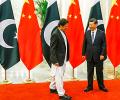
'If a 'two-front war' develops, Iron Brother may only turn out to be a drag on the PLA, since Pakistan is in no position to wage a war with India,' argues Ambassador M K Bhadrakumar.
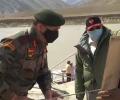
'We should not minimise the seriousness of Chinese encroachments because their perception is different.' 'Nor should we fall into the trap of accepting so-called 'buffer zones' in areas of overlapping claims. We cannot have buffer zones in our own territory,' asserts Ambassador Shyam Saran, a former foreign secretary.

One has to wonder what is so wrong with the European Union.

More than India's alignment with the Quad, India's defence cooperation and partnership with the USA is of critical importance, notes Rup Narayan Das.
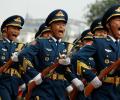
'India knows very well that China will not be at a disadvantage in any China-India military operations along the border area'
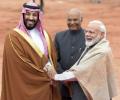
'No matter what Modi may boast about 'new India', the geopolitical reality is that India's stature diminishes when it needs a small country like Saudi Arabia under an autocratic ruler to help out with what is arguably one of the most critical templates of its diplomacy,' says Ambassador M K Bhadrakumar.
According to report in the China Daily, Washington could be furthering its geopolitical interests in the region by acting through its private non-governmental organisation, the National Endowment for Democracy (NED).

Against the backdrop of the standoff between Indian and Chinese troops in eastern Ladakh, the White House press secy said the United States was closely monitoring the current situation and supports its peaceful resolution.

"The basic idea is that India would like to continue to be the most beautiful woman wooed by all men, notably the two strongest in the house, US and China," the article titled 'Indo-US strategic distrust stalls LSA signing'.

'We try to pick up stocks early and hold onto them for the long term.' 'We are not someone who buys and sells on a daily basis.'

As the majority of Pakistani airspace has remained closed for Indian airlines since the Balakot strike on February 26, the decision to avoid affected Iranian airspace on Saturday is going to further disturb the routes of their international flights towards middle-eastern and European countries, and the US.
Colonel Anil A Athale (retired) examines the geopolitics of the regions and explains ways in which India and step into the power vacuum that exists there.

'Rajapaksa's victory poses a serious foreign policy challenge for the Modi government,' notes Ambassador M K Bhadrakumar.

In an address to the air warriors on the occasion of the 89th Air Force Day, the Chief of Air Staff also said that the IAF must demonstrate to the nation that external forces will not be allowed to violate its territory.

Reliance Industries Ltd (RIL) was the star performer in Friday's session, spurting over 6 per cent to its all-time high, Other Sensex gainers included Bajaj Finance, PowerGrid, ICICI Bank, Maruti, Axis Bank and SBI. On the other hand, IndusInd Bank, HCL Tech, ITC, M&M HDFC and Infosys shed up to 2.94 per cent.

'China is constantly probing India's weaknesses.' 'The challenge is to implement a strategy that will allow India to buy time, gather its strength, and eventually counter China,' recommends Harsh V Pant and Vinay Kaura.

The festering dispute over the accession of Jammu and Kashmir stands out as one of the world's most volatile fault lines that divides regions, countries, societies, communities and ethnic groups, notes Mohammad Sayeed Malik, the distinguished commentator on Kashmir affairs, on Sheikh Abdullah's 39th death anniversary.

The days of a thousand cuts are over. These mini wars will remain under the threshold of undeniable war, but will escalate closer to that threshold when their big brother pushes in. Chinese aggression has changed the matrix, the strategies, and surely the objectives too, warns David Devadas.
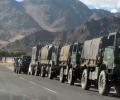
India on Friday said the onus is on China to address the remaining unresolved issues relating to the eastern Ladakh row and that peace and tranquillity along the frontier were key for the restoration of normal relations between the two sides.

Continued uncertainty or confrontation in the Asia-Pacific is clearly in no one's interest as it will affect major powers' attempts to restructure their economies and revive growth. Conflict would roll back the gains to each of our countries of 40 years of stability and peace, says Shivshankar Menon.

Further deterioration of the US-Saudi relationship will have geo-economic and geopolitical effects, says Nitin Pai.

India-Maldives ties came under strain under Yameen who was perceived to be close to China.

It will not be to India's advantage to create misperceptions that it is bandwagoning with some Anglo-American project for regime change in Myanmar, argues Ambassador M K Bhadrakumar.
